
How Many Sleep Cycles Do You Need Per Night?
Most adults need five to six sleep cycles a night. A sleep cycle lasts about 90 minutes on average, so five cycles is 7 hours 30 minutes and six cycles is 9 hours, which fits the 7 or more hours of sleep recommended for adults. This guide explains what a sleep cycle is, how long it lasts, how many hours you need at each age, and how to turn that into a bedtime and a wake-up time.
The short answer
- Length: about 90 minutes on average. The first cycle of the night is often shorter (70 to 100 minutes) and later ones run 90 to 120 minutes.
- Per night: a typical night has four to six sleep cycles.
- For adults: five cycles (7 hours 30 minutes) or six (9 hours) meet the 7 or more hours recommended. Four cycles (6 hours) falls short.
- Your bedtime: wake-up time minus the cycles you want, minus about 15 minutes to fall asleep.
- It is an estimate: cycle length varies from person to person and from night to night.
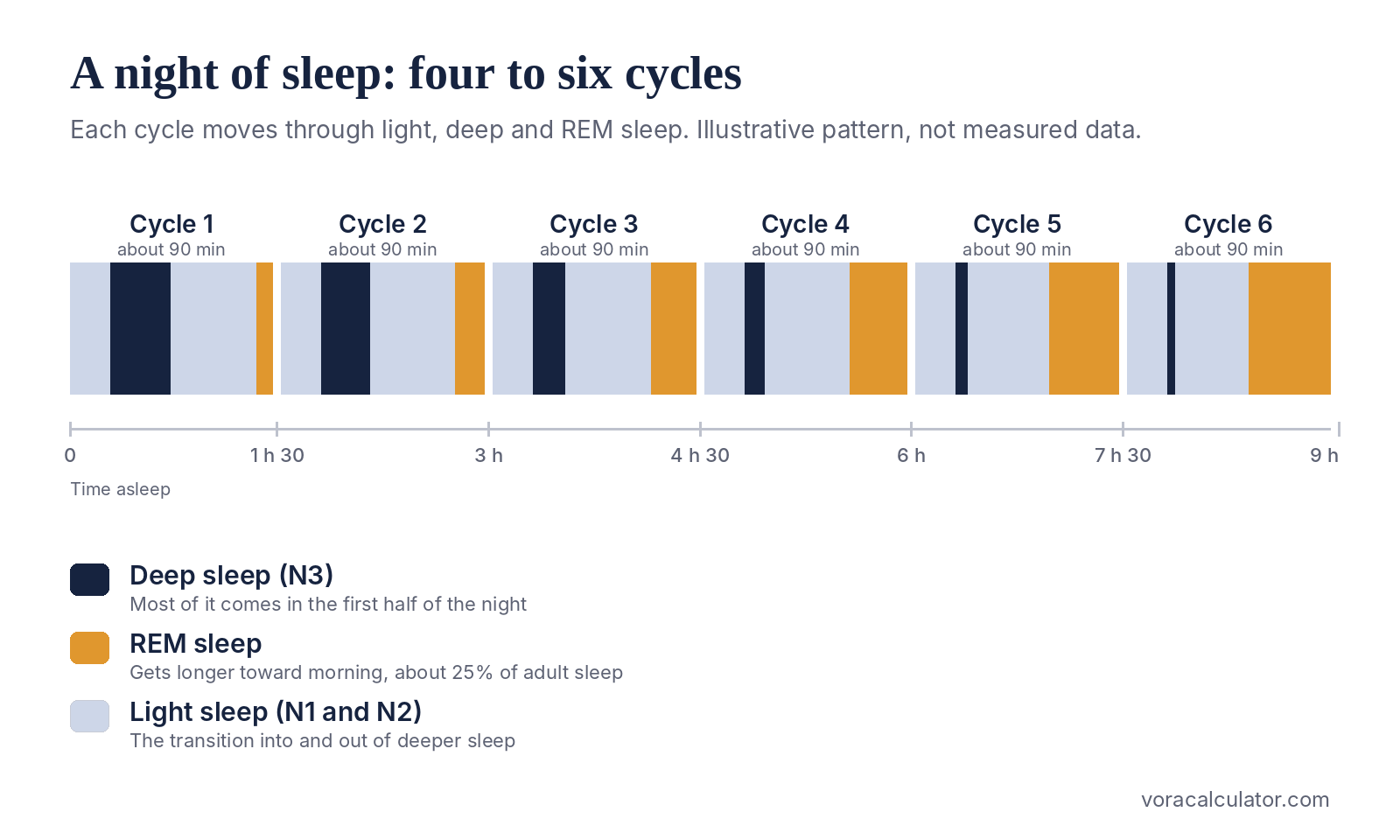
What is a sleep cycle?
A sleep cycle is one full pass through the stages of sleep. You move from light sleep into deep sleep and then into REM (rapid eye movement) sleep, and the pattern repeats several times a night. The stages are usually labelled N1, N2, N3 and REM.
- N1: the lightest stage, which happens as you first fall asleep.
- N2: the body starts to relax more deeply.
- N3: deep sleep, the deepest and most restorative stage.
- REM: the stage where most dreaming happens. It makes up around 25% of sleep in adults.
The mix changes as the night goes on. You spend the most time in deep sleep in the first half of the night, while REM stages get longer, especially in the second half. You do not enter REM until you have been asleep for about 90 minutes.
How long is a sleep cycle?
On average a sleep cycle lasts about 90 minutes. The first cycle of the night is often the shortest, ranging from 70 to 100 minutes, and later cycles tend to fall between 90 and 120 minutes. That makes 90 minutes a sensible figure for planning, but not an exact one for any single person or night. Your own cycles can be shorter or longer, so treat 90 minutes as a starting point.
How many sleep cycles do you need?
In a typical night a person goes through four to six sleep cycles. How many you need depends on how much sleep your body needs. For adults the CDC recommends 7 or more hours, and the Sleep Foundation says most healthy adults need between 7 and 9 hours. Here is what that looks like in 90-minute cycles:
| Sleep cycles | Time asleep | Enough for an adult? |
|---|---|---|
| 1 | 1 h 30 min | No |
| 2 | 3 h | No |
| 3 | 4 h 30 min | No |
| 4 | 6 h | Below the recommended 7 or more hours |
| 5 | 7 h 30 min | Yes, within the 7 to 9 hour range |
| 6 | 9 h | Yes, at the top of the 7 to 9 hour range |
| 7 | 10 h 30 min | Longer than the 7 to 9 hours most healthy adults need |
Calculated with 90-minute cycles. Time asleep does not include the minutes it takes to fall asleep.
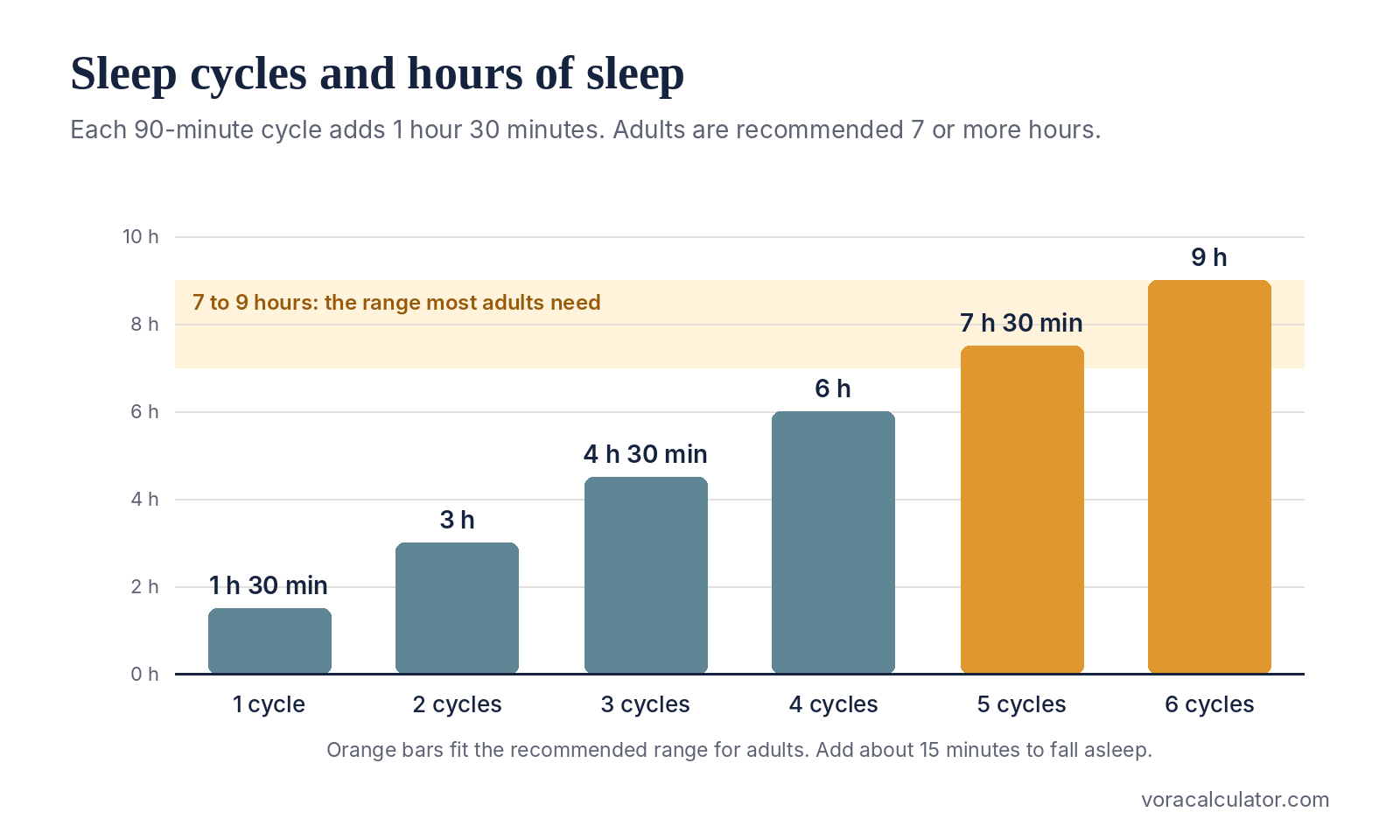
Five cycles is the smallest whole number of 90-minute cycles that reaches 7 hours. Four cycles (6 hours) falls short. Because it takes time to fall asleep, you need to be in bed for about 7 hours 45 minutes to get five full cycles.
How many hours of sleep do you need by age?
The number of hours you need changes as you get older. This is the CDC’s guidance for each age group, per 24 hours:
| Group | Age | Recommended sleep |
|---|---|---|
| Newborn | 0–3 months | 14–17 hours |
| Infant | 4–12 months | 12–16 hours (including naps) |
| Toddler | 1–2 years | 11–14 hours (including naps) |
| Preschool | 3–5 years | 10–13 hours (including naps) |
| School age | 6–12 years | 9–12 hours |
| Teen | 13–17 years | 8–10 hours |
| Adult | 18–60 years | 7 or more hours |
| Adult | 61–64 years | 7–9 hours |
| Adult | 65 years and older | 7–8 hours |
Source: CDC, About Sleep (checked 12 October 2026).
Teenagers are recommended 8 to 10 hours, which is roughly 5⅓ to 6⅔ cycles, so six full cycles (9 hours) sits in the middle of the range. For adults aged 65 and over, 7 to 8 hours is roughly five cycles. The 90-minute figure is an adult average, so cycles are best used to plan sleep for adults and teenagers. For babies and children, follow the hours above and ask a doctor if you are unsure about their sleep.
How to work out your bedtime by hand
Count backwards from the time you need to wake up. Choose how many cycles you want, take off that many 90-minute blocks, then take off the time it usually takes you to fall asleep. For healthy adults a normal time to fall asleep is about 10 to 20 minutes, so 15 is a sensible default.
- Decide when you need to wake up, for example 6:30 am.
- Choose five cycles (7 hours 30 minutes) or six cycles (9 hours).
- Subtract the cycles. Five cycles back from 6:30 am is 11:00 pm, and six cycles back is 9:30 pm.
- Subtract 15 minutes to fall asleep. That gives a bedtime of 10:45 pm for five cycles or 9:15 pm for six.
The table shows bedtimes for a few common wake-up times with 15 minutes to fall asleep. The Sleep Calculator has a longer chart, and it also works out wake-up times if you go to bed at a set time or right now.
| Wake up at | Bedtime for 5 cycles | Bedtime for 6 cycles |
|---|---|---|
| 6:00 am | 10:15 pm | 8:45 pm |
| 6:30 am | 10:45 pm | 9:15 pm |
| 7:00 am | 11:15 pm | 9:45 pm |
| 8:00 am | 12:15 am | 10:45 pm |
Should you wake up at the end of a sleep cycle?
Many people plan around sleep cycles because waking in the middle of deep sleep tends to feel worse. Grogginess after waking is called sleep inertia. It usually lasts 15 to 60 minutes, and it typically happens when you wake abruptly from a deep sleep, most often during N3.
Setting an alarm for the end of a cycle is a reasonable way to improve your chances of waking in lighter sleep, but it is only an estimate. Your cycle lengths vary, and only a sleep study can measure your sleep stages directly, so no calculator can promise that you will wake in light sleep. Total sleep matters too: not getting enough sleep can cause or worsen sleep inertia.
Why you can feel tired after a full night
If you spend enough hours in bed but still wake up exhausted, the number of cycles may not be the reason. Common causes include:
- Not enough sleep overall. Insufficient sleep can cause or worsen grogginess on waking, whatever time your alarm goes off.
- An irregular schedule. Going to bed and getting up at similar times each day helps your body know when it is time to sleep. Sleeping in at weekends can make early weekday wake-ups harder.
- Things that disrupt sleep. Alcohol, some medicines and health conditions such as obstructive sleep apnoea can all affect how you feel on waking.
- Night shift work. Working at night can lead to shift work sleep disorder, which makes grogginess more likely.
If you regularly wake up exhausted despite enough time in bed, or you snore loudly or stop breathing in your sleep, speak with a doctor.
Tips for getting full cycles of sleep
- Keep regular times. Go to bed and get up at similar times each day, including on days off.
- Make the room right. A bedroom that is quiet, dark and cool is easier to sleep in.
- Wind down without screens. Try not to use phones, tablets or computers for an hour before bed.
- Watch caffeine. Tea, coffee and some soft drinks contain caffeine, which can make you feel more awake, so avoid it late in the day.
- Get up when the alarm goes off. Resist the snooze button, get moving and get some morning light to shake off sleep inertia faster.
Sleep Cycles — FAQs
How many sleep cycles are in 8 hours?
About five. Eight hours is 480 minutes, which is five full 90-minute cycles (450 minutes) plus 30 minutes. If it takes you 15 minutes to fall asleep, you get about 465 minutes of sleep, which is just over five cycles.
How many hours is 5 sleep cycles?
Seven hours 30 minutes with 90-minute cycles. Add about 15 minutes to fall asleep and you need to be in bed for about 7 hours 45 minutes.
How many hours is 6 sleep cycles?
Nine hours with 90-minute cycles, or about 9 hours 15 minutes in bed once you allow 15 minutes to fall asleep.
Is 4 sleep cycles enough?
Four cycles is about 6 hours, which is below the 7 or more hours recommended for adults. If you regularly get four cycles, an earlier bedtime or a later wake-up time would bring you closer to five.
What is the 90-minute sleep rule?
It is the idea of planning sleep in blocks of about 90 minutes, the average length of one sleep cycle, so that your alarm goes off at the end of a cycle rather than in the middle of deep sleep. It is a useful planning rule, but cycle length varies, so it is an estimate rather than an exact science.
How much of the night is REM sleep?
REM sleep makes up around 25% of sleep in adults. REM stages get longer through the night, especially in the second half, while deep sleep is concentrated in the first half of the night.
Sources
- CDC: About SleepRecommended hours of sleep for every age group, from newborns to adults aged 65 and over.
- Sleep Foundation: Stages of SleepThe four stages, an average cycle of about 90 minutes (70 to 100 for the first, 90 to 120 for later cycles), four to six cycles a night, and how deep and REM sleep change across the night.
- Sleep Foundation: How Much Sleep Do Adults Need?Most healthy adults need between 7 and 9 hours of sleep each night.
- Sleep Foundation: Sleep LatencyA normal time to fall asleep is about 10 to 20 minutes.
- Sleep Foundation: Why Is It So Hard to Wake Up?Sleep inertia and why a regular schedule, including at weekends, makes waking easier.
- Cleveland Clinic: Sleep InertiaGrogginess after waking usually lasts 15 to 60 minutes and is most likely after waking abruptly from deep sleep; causes and ways to reduce it.
- NHS Every Mind Matters: Fall asleep faster and sleep betterRegular bed and wake-up times, a quiet, dark, cool bedroom, caffeine and screens before bed.
Good to know
This guide is general information, not medical advice. Sleep cycles vary from person to person and from night to night, so the times in this guide are estimates. Facts were last checked against the sources above on 12 October 2026. If you have ongoing trouble sleeping or feel unwell, speak with a doctor.