
How to Calculate Your Conception Date
Your conception date is the day an egg was fertilised, and you can estimate it in three ways: by counting back from your due date, by adding days to the first day of your last period, or from an ovulation date you tracked. Each gives a best guess rather than an exact day, because ovulation timing varies and sperm can survive for several days. This guide shows the formulas, worked examples and how much to trust the result.
The short answer
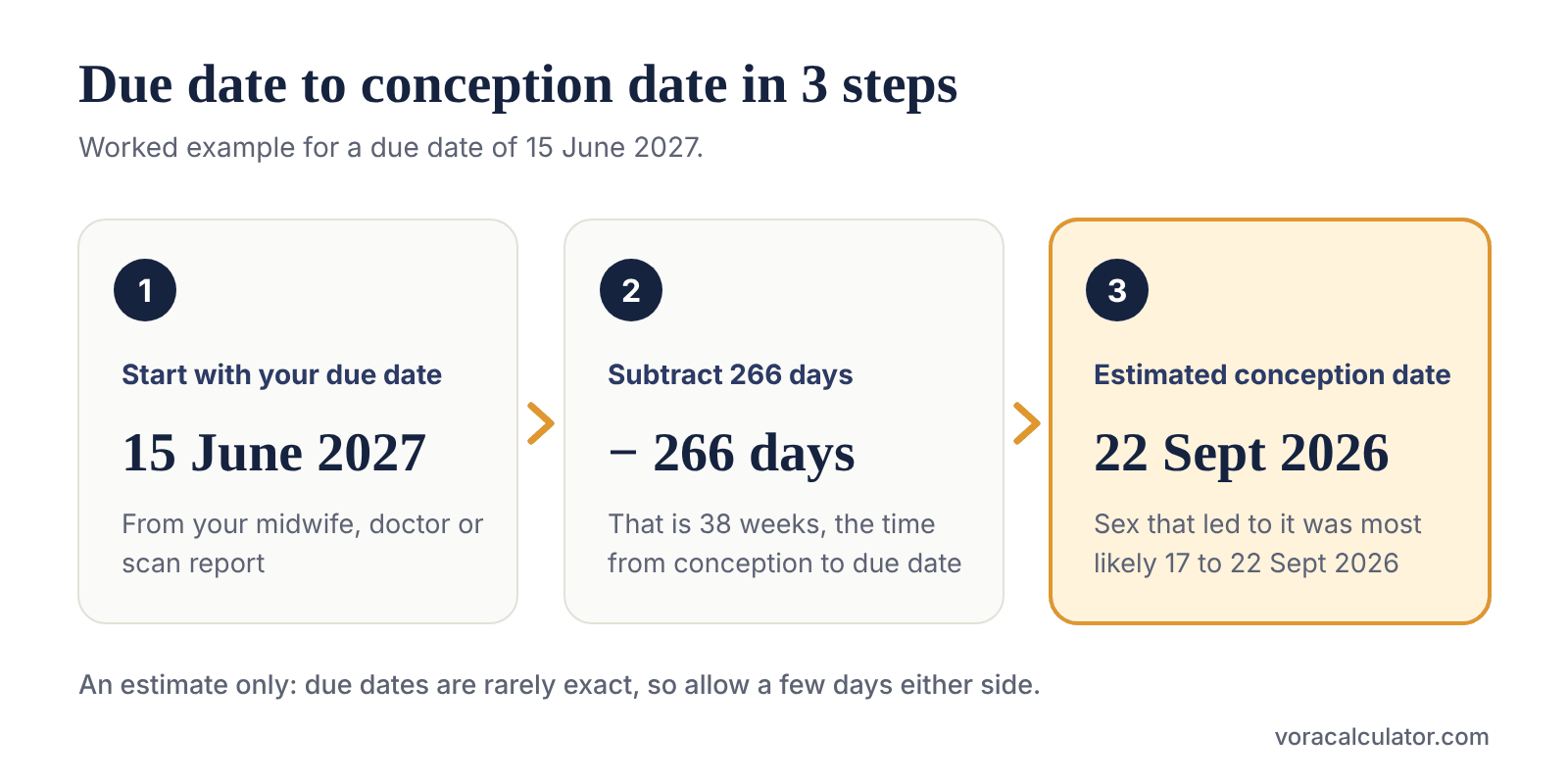
- From your due date: subtract 266 days (38 weeks). A due date of 15 June 2027 gives about 22 September 2026.
- From your last period: add your cycle length minus 14 days. With a 28-day cycle that is 14 days after the first day of your last period.
- From ovulation: conception most likely happened that day or the next, because the egg survives only 12 to 24 hours.
- It is an estimate: sperm can survive for up to about five days, so treat the result as a window of several days.
What a conception date is
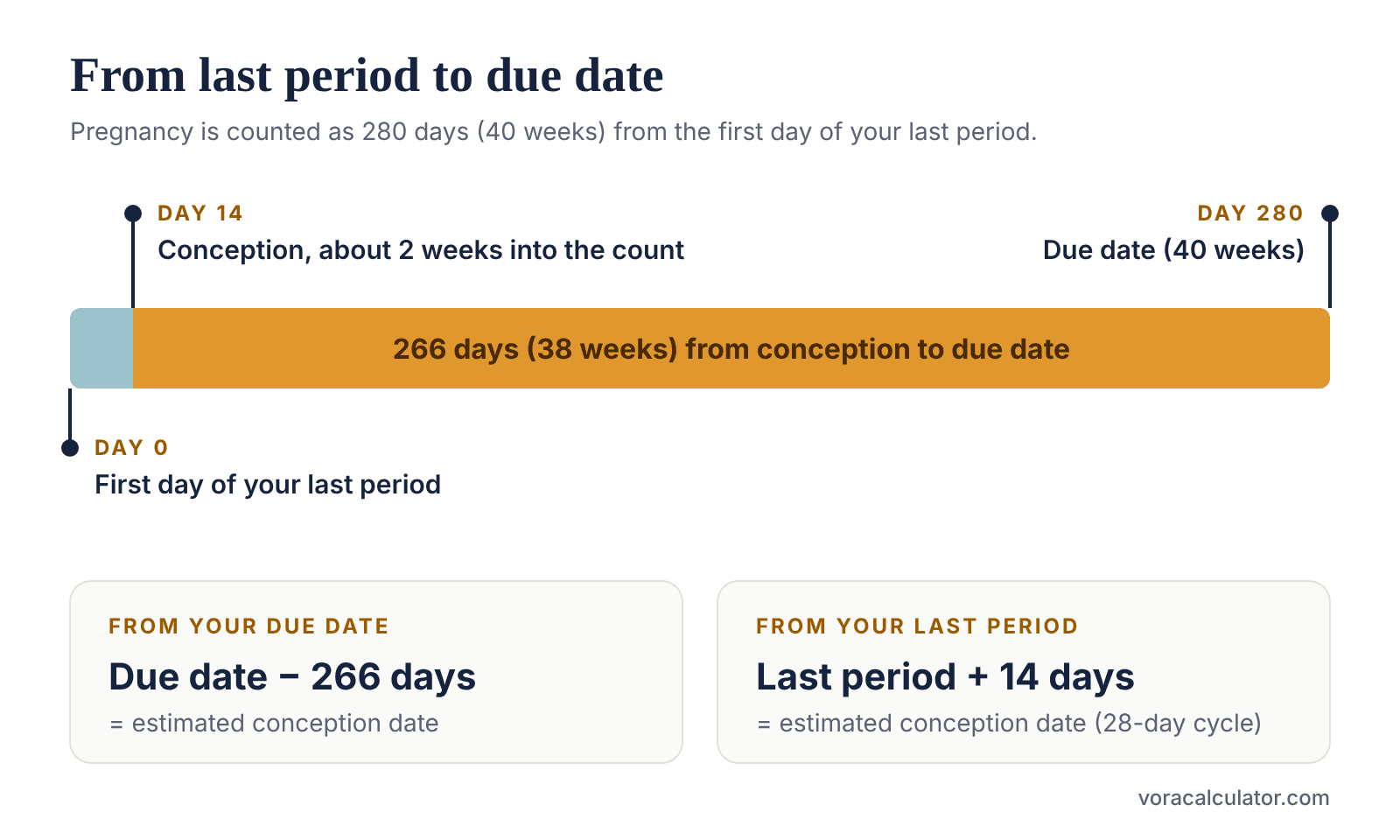
Your conception date is the day a sperm fertilised an egg. It is not the day a pregnancy test turned positive, and it is not the date you count weeks of pregnancy from. Doctors and midwives count pregnancy from the first day of your last period, which is about two weeks before conception. By convention the due date is 280 days after that first day, and about 266 days (38 weeks) of the pregnancy follows conception. That 14-day gap is what every method below relies on.
Method 1: Count back from your due date
This is the simplest method, and the most reliable one if your due date has been confirmed by a scan.
- Take your due date from your midwife, doctor or scan report.
- Subtract 266 days (38 weeks).
- Treat the date you get as the likely day of conception, and the five days before it as the most likely days for the sex that led to the pregnancy.
The table shows the estimated conception date for a due date on the 15th of each month, and whether it falls in the same year as the due date or the year before. If 29 February falls between the two dates, the conception date is one day later than shown.
| Due date | Estimated conception date |
|---|---|
| 15 January | 24 April (year before) |
| 15 February | 25 May (year before) |
| 15 March | 22 June (year before) |
| 15 April | 23 July (year before) |
| 15 May | 22 August (year before) |
| 15 June | 22 September (year before) |
| 15 July | 22 October (year before) |
| 15 August | 22 November (year before) |
| 15 September | 23 December (year before) |
| 15 October | 22 January (same year) |
| 15 November | 22 February (same year) |
| 15 December | 24 March (same year) |
Calculated as the due date minus 266 days. Your own result can differ by a few days, because the due date itself is an estimate.
Method 2: From the first day of your last period
If you know the first day of your last period, add the number of days from the start of your cycle to ovulation. Ovulation usually happens about 14 days before your next period starts, so the number to add is your cycle length minus 14.
The luteal phase is the time from ovulation to your next period, and 14 days is typical. The table uses a last period that started on 1 October 2026 and the typical 14-day luteal phase. The due date in the last column is the conception date plus 266 days.
| Cycle length | Estimated conception | Due date |
|---|---|---|
| 24 days | 11 Oct 2026 | 4 Jul 2027 |
| 28 days | 15 Oct 2026 | 8 Jul 2027 |
| 32 days | 19 Oct 2026 | 12 Jul 2027 |
The 28-day row matches Naegele’s rule for the due date: add 7 days to the first day of your last period, subtract 3 months and add a year (1 October 2026 gives 8 July 2027).
This method depends on a regular cycle and on remembering the first day of your last period accurately. If your cycles vary a lot, the result can be a week or more out.
Method 3: From ovulation tracking or a scan
If you tracked ovulation with ovulation tests, temperature charts or other signs, conception most likely happened on that day or the next, because the egg survives for only 12 to 24 hours after it is released. This can be more precise than the calendar methods, as long as you are confident about the ovulation date.
If you had an early scan, use the due date it gives you and apply Method 1. Your care team may change a due date that came from your last period if the scan measurement differs by a certain amount. ACOG’s guidance is to move the due date to the scan’s estimate when the difference is more than 7 days before 14 weeks of pregnancy, or more than 5 days before 9 weeks. When the due date moves, the estimated conception date moves with it.
Why conception is a range, not a single day
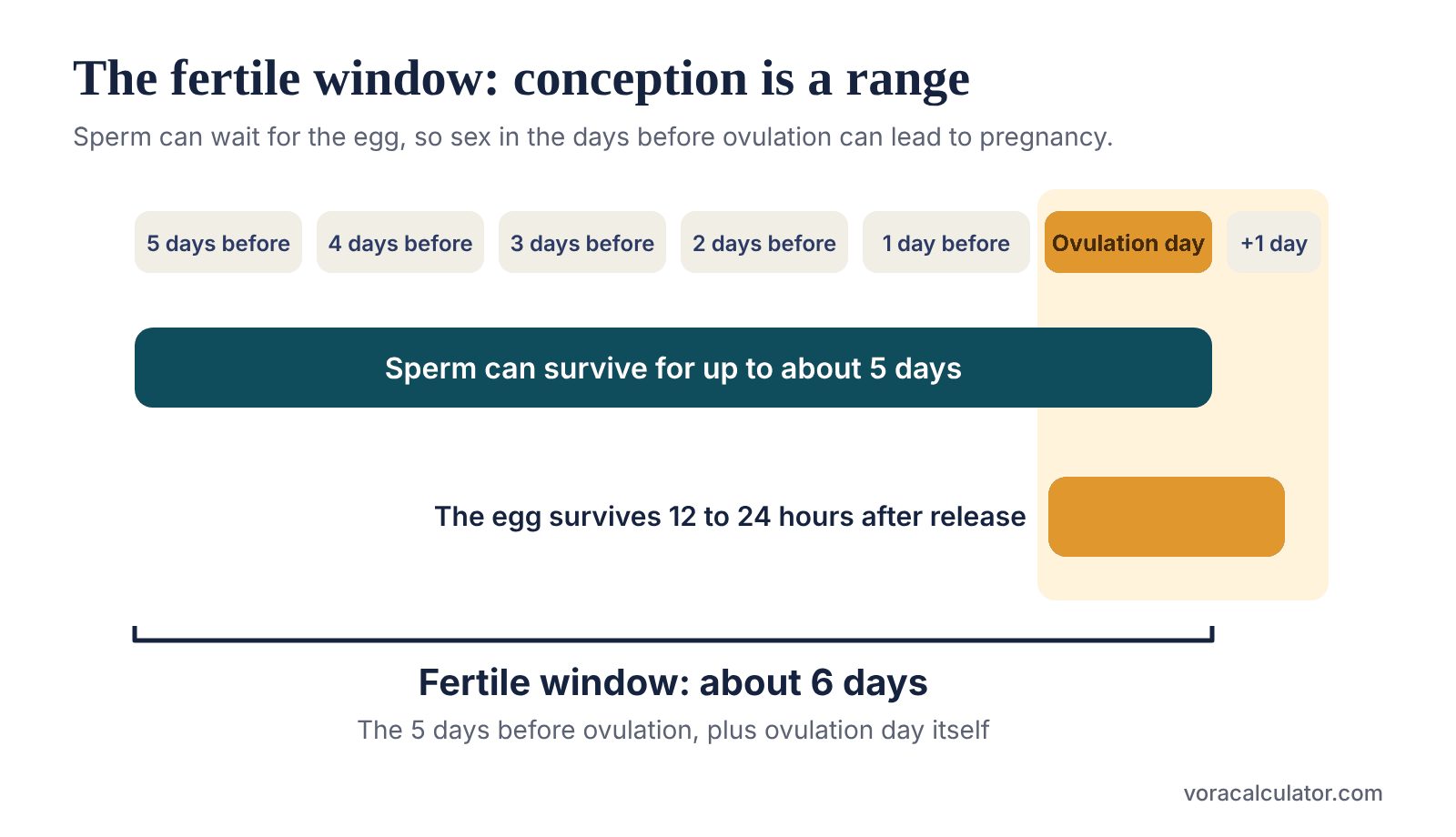
You are fertile for about six days in each cycle: the five days before ovulation and ovulation day itself. Sperm can live in the body for up to about five days, and the egg can be fertilised for 12 to 24 hours after it is released. That means the sex that led to a pregnancy can have happened several days before the egg was actually fertilised.
How accurate is an estimated conception date?
- Due dates are estimates. Only about 4% of babies are born on their due date, and pregnancy normally lasts from 37 to 42 weeks from the first day of your last period.
- Every day counts one for one. If your due date moves by 3 days, so does your estimated conception date.
- Ovulation does not always follow the textbook. The calendar methods assume a typical luteal phase, and ovulation can come earlier or later in any cycle.
- A conception date is not an intercourse date. Use the six days ending on the estimate as the likely window.
Common mistakes
- Counting 40 weeks from conception. The 40 weeks start about two weeks earlier, at the first day of your last period. From conception it is about 38 weeks.
- Using the end of your period instead of the first day. The pregnancy count always starts on the first day of bleeding.
- Ignoring cycle length. A 32-day cycle puts conception about four days later than a 28-day cycle.
- Mixing up due dates. Use the latest due date from your care team, not an earlier estimate that a scan has since replaced.
What this guide does not cover
- Assisted conception. If you conceived with IVF or another fertility treatment, your clinic has exact dates and can work out your due date from them.
- Medical advice. A calculated date does not replace dating from your midwife or doctor, who can combine your cycle history with scan measurements.
Conception date questions answered
How do you calculate your conception date from your due date?
Subtract 266 days (38 weeks) from your due date. For a due date of 15 June 2027, that gives an estimated conception date of 22 September 2026. Because sperm can survive for up to about five days, the sex that led to the pregnancy most likely took place in the six days ending on that date.
How do you calculate your conception date from your last period?
Add your cycle length minus your luteal phase to the first day of your last period. With a 28-day cycle and the typical 14-day luteal phase, that is 14 days. A last period starting on 1 October 2026 gives an estimated conception date of 15 October 2026. The method works best when your cycles are regular.
How many weeks pregnant am I at conception?
About two weeks. Pregnancy weeks are counted from the first day of your last period, which is roughly 14 days before conception, so a pregnancy is already around 2 weeks old by the count when the egg is fertilised.
Can you work out the exact day of conception?
Not reliably. Ovulation timing varies, sperm can survive for up to about five days and an egg for 12 to 24 hours, and due dates are estimates. A calculated conception date is best read as a window of several days.
Why doesn’t my conception date match the day I had sex?
Sperm can wait in the body for up to about five days before an egg is released, so sex up to five days before the estimated conception date could be the one that led to the pregnancy. Ovulation can also happen earlier or later than the typical timing, which moves the estimate.
Does my conception date change if my due date changes after a scan?
Yes. The conception date is worked out from the due date, so if a dating scan moves your due date by a few days, your estimated conception date moves by the same number of days.
How many babies are born on their due date?
Only about 4%. Pregnancy normally lasts anywhere from 37 to 42 weeks from the first day of the last period, so a due date is the middle of a range rather than a deadline.
Sources
- ACOG: Methods for Estimating the Due Date (Committee Opinion No. 700)The due date is 280 days after the first day of the last menstrual period, and when a scan should change it.
- ACOG: Trying to Get Pregnant? Here’s When to Have SexThe fertile window of about six days, sperm survival of up to five days, egg survival of 12 to 24 hours, and ovulation about 14 days before a period.
- Cleveland Clinic: Due Date CalculatorAbout 266 days (38 weeks) from conception to due date, Naegele’s rule, and the share of babies born on their due date.
- NHS: Pregnancy due date calculatorPregnancy normally lasts 37 to 42 weeks from the first day of the last period.
- NHS: Trying to get pregnantOvulation usually happens about 14 days before the start of the next period.
- Mayo Clinic: Sperm, how long do they live after ejaculation?Sperm can typically stay alive for about 3 to 5 days in the female reproductive tract.
Good to know
This guide is general information, not medical advice. A calculated conception date is an estimate and cannot tell you the exact day of intercourse or fertilisation. Facts were last checked against the sources above on 11 October 2026. If you have questions about your own dates, ask your midwife or doctor.