
How to Calculate Retirement Savings With Inflation
A practical guide to the numbers behind a retirement savings projection: your starting balance, monthly contributions, time, assumed growth and inflation. Follow the worked example, then test your own inputs in the free calculator.
By Vora Calculator · Published 25 October 2026 · Worldwide examples

How do you calculate retirement savings?
Start with the amount you already have, add the contributions you plan to make, and project both over the years until your chosen retirement age. An assumed rate of return models growth. An inflation assumption then converts the future balance into today’s purchasing power.
For a transparent example, someone aged 40 with 40,000 saved, adding 300 at the end of each month for 25 years at a constant 4% annual return, reaches 262,789.47. At 2% annual inflation, that is worth about 160,178.29 in today’s money. These are fictional assumptions, not expected returns or inflation forecasts.
1. Gather the six inputs
| Input | What to enter | Example |
|---|---|---|
| Current age | Your age at the start of the projection | 40 |
| Retirement age | Your chosen saving end date, not an official pension age | 65 |
| Current savings | Money already set aside for this projection | 40,000 |
| Monthly contribution | A fixed deposit at the end of each month | 300 |
| Annual return | An assumed nominal yearly rate | 4% |
| Annual inflation | An assumption about price growth | 2% |
Keep all money amounts in the same currency. Choosing PKR, USD, EUR or another display currency does not exchange money or load local tax rules. If your savings are held in several currencies, convert them to one consistent basis before adding them.
For this model, use an assumed return after recurring investment fees where possible. It does not calculate tax liabilities or account-specific fees. Avoid subtracting inflation from the return and then also entering inflation in its own field: that would mix a real-return assumption with a second inflation adjustment.
2. Understand how contributions and growth combine
The calculator applies the assumed annual return divided by 12 each month, then adds that month’s contribution. That timing matters: a contribution made at the end of a month does not earn growth during that same month. The current balance has the full saving period to grow, while later contributions have less time.
In the example, the age gap is 25 years, or 300 months. New contributions total 300 × 300 = 90,000. Adding the initial 40,000 gives 130,000 in total contributions. The difference between the final balance and 130,000 is the model’s estimated growth.
With no growth, the result is simply 130,000. The 0% case is a useful arithmetic baseline; it is not a prediction about an investment. A positive constant return is also a simplification: actual returns can fluctuate and include losses.
The retirement savings formula
For a monthly contribution model, the future value is:
P is the current balance, C is the monthly contribution, r is the annual percentage divided by 100 and 12, and n is the number of months. At a zero return, use P + C × n instead of dividing by r.
Vora’s Retirement Calculator implements the same idea month by month and rounds the age gap to a whole number of months. It uses a nominal annual rate divided into monthly periods. If a product quotes an effective annual yield, simply dividing that yield by 12 is a different convention, so align the assumptions before comparing results.
3. Adjust the balance for inflation
A larger future balance does not necessarily buy as much as the same number would buy today. Inflation changes purchasing power. Investor.gov explains purchasing power as what a unit of currency can buy after allowing for inflation.
Use a decimal rate in the formula: 2% means 0.02. In this illustration, 262,789.47 ÷ 1.0225 is approximately 160,178.29. No money has been removed from the account by this calculation. It is a second way to express the same future sum.
The chart holds the initial balance, monthly deposit and assumed rates constant while changing the saving period. The gap between the bars shows why a future account balance and its present purchasing power should be read separately.
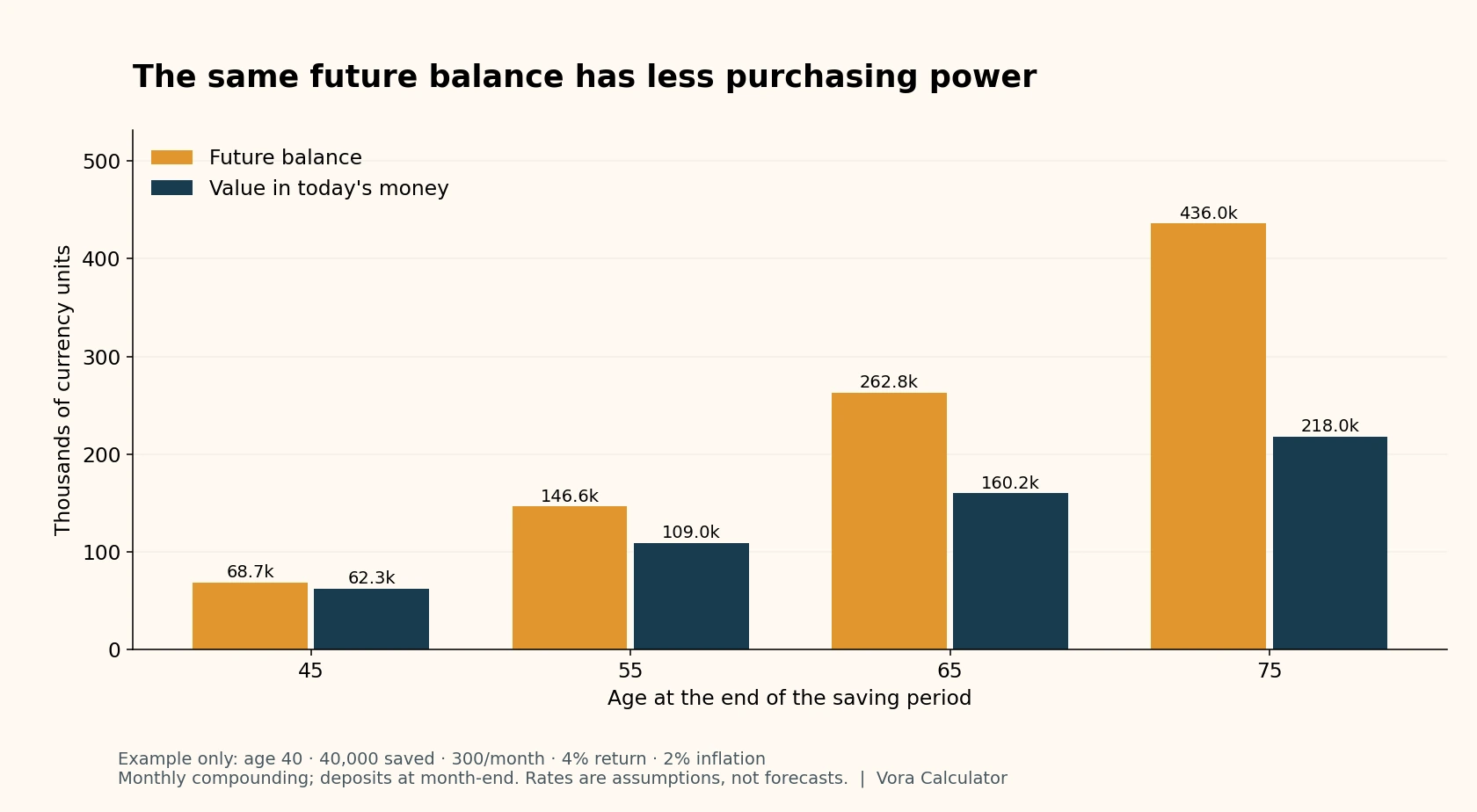
| Age | Years saving | Future balance | In today’s money |
|---|---|---|---|
| 45 | 5 | 68,729.56 | 62,250.48 |
| 55 | 15 | 146,639.21 | 108,955.09 |
| 65 | 25 | 262,789.47 | 160,178.29 |
| 75 | 35 | 435,950.07 | 217,987.07 |
4. Compare assumptions instead of relying on one result
Hold the starting balance at 40,000, the deposit at 300 per month and the saving period at 25 years. Changing only the return shows how much the projection depends on that input. The inflation adjustment below stays at 2%.
| Assumed annual return | Future balance | In today’s money |
|---|---|---|
| 0% | 130,000.00 | 79,239.01 |
| 2% | 182,567.75 | 111,280.68 |
| 4% | 262,789.47 | 160,178.29 |
| 6% | 386,496.98 | 235,581.84 |
These values are a sensitivity comparison, not a recommended range of returns. The higher-rate rows should not be read as a promise. This calculator does not model changing returns, investment volatility or the probability of reaching a target.
Next, change the monthly deposit while keeping the 4% return and 25-year period fixed:
| Monthly contribution | Total contributions including initial savings | Future balance |
|---|---|---|
| 200 | 100,000.00 | 211,376.52 |
| 300 | 130,000.00 | 262,789.47 |
| 400 | 160,000.00 | 314,202.43 |
Changing one assumption at a time makes the comparison easier to interpret. A contribution increase has a direct arithmetic effect, but whether it fits your budget is a separate question.
5. Compare the projection with a retirement spending target
The balance at retirement is not the same thing as a sustainable retirement income. This tool stops at the saving end date. It does not calculate withdrawals, pension entitlements, life expectancy or how long a pot will last.
Begin a separate spending estimate in today’s money, allowing for the categories relevant to you, such as housing, food, transport and healthcare. List the pension or other income you expect separately. A gap between spending and income is a planning input, not a number this savings-growth tool can automatically solve.
Keep the units consistent. Compare a target stated in today’s prices with the inflation-adjusted result, or a target stated in future prices with the nominal result. Comparing a future balance directly with today’s spending can make the projection look more generous than it is.
If you already have a savings target, try the Savings Calculator to explore deposits and time. The Compound Interest Calculator helps compare compounding assumptions. Neither replaces local pension forecasts or a full retirement-income plan.
Common mistakes when using a retirement calculator
- Mixing annual and monthly deposits. Enter a monthly contribution, not the total you plan to save each year.
- Treating an assumption as a forecast. A smooth fixed return makes the calculation repeatable; it does not describe the path of an investment.
- Counting the same money twice. Keep your initial balance separate from future monthly contributions.
- Ignoring contribution timing. This model adds deposits at the end of each month.
- Assuming deposits rise with inflation. The amount stays fixed throughout this projection.
- Reading the chosen retirement age as an entitlement date. No country’s pension rules are applied.
Save the assumptions alongside your result so you can reproduce the comparison later. Revisit the calculation when the inputs change, rather than treating one saved number as a permanent answer.
Retirement savings questions answered
How much should I save each month for retirement?
There is no single monthly amount for everyone. This tool shows the projected effect of a contribution you choose. Compare different deposits with a separately defined target, budget and expected pension income.
Does a retirement calculator work in any country?
This savings-growth model works with consistent currency inputs and your chosen assumptions. It does not calculate national pension ages, tax relief, contribution limits or benefit eligibility.
What is the difference between nominal and real retirement savings?
Nominal savings are the future currency balance. The inflation-adjusted figure expresses the purchasing power of that balance in today’s money under your inflation assumption.
Does the calculator include pension withdrawals?
No. It projects savings until the age you enter. It does not model retirement spending, withdrawal rates or how long the balance might last.
What happens if I set the expected return to zero?
The final balance is the initial savings plus all monthly contributions. In the worked example, 40,000 plus 300 deposits of 300 equals 130,000.
Can I use an actual inflation rate instead of the example?
You can enter your own assumption. A recent observed inflation rate describes a past period; it does not establish the rate over the whole future saving period. The guide’s 2% is an illustration only.
Sources and calculation notes
Published 25 October 2026 by Vora Calculator. Numerical examples are original calculations from the stated monthly model. They are educational illustrations, not product quotes or financial recommendations. No current national rates or pension thresholds are stored in this guide.
- SEC Investor.gov: Compound Interest Calculator — background on starting balances, monthly contributions, time and assumed rates.
- SEC Investor.gov: Purchasing Power — the relationship between money and what it can buy.
Put your own numbers to work
Choose one set of inputs, note the assumptions, then change just one variable for a useful comparison.
Calculate your retirement savings